

The labyrinth seal is a critical component in various industrial applications, especially in rotating machinery such as turbines, compressors, and pumps. Its main function is to minimize fluid leakage between different pressure zones while allowing relative motion between parts. One of the key factors that significantly influence the performance of a labyrinth seal is the material elasticity of its components. In this blog, as a labyrinth seal supplier, I will delve into how the material elasticity affects the seal's performance.
Understanding Material Elasticity
Material elasticity refers to the ability of a material to deform under stress and return to its original shape when the stress is removed. This property is characterized by the material's Young's modulus, which is a measure of the stiffness of the material. A material with a high Young's modulus is relatively stiff and will deform less under a given stress, while a material with a low Young's modulus is more flexible and will deform more easily.
In the context of labyrinth seals, the material elasticity plays a crucial role in determining how the seal responds to various operating conditions, such as pressure differentials, temperature changes, and shaft vibrations.
Impact on Leakage Reduction
One of the primary performance indicators of a labyrinth seal is its ability to reduce fluid leakage. The elasticity of the seal material can have a significant impact on this aspect. When a labyrinth seal is subjected to a pressure differential across it, the seal material will deform to some extent. A more elastic material will deform more readily, allowing the seal to conform better to the mating surfaces and reduce the leakage path.
For example, in a turbine application, the high - pressure steam on one side of the labyrinth seal creates a pressure force that acts on the seal. If the seal material has appropriate elasticity, it can deform to fill any small gaps or irregularities between the seal and the shaft, thus reducing the steam leakage. On the other hand, a stiff material may not be able to conform well to the surface irregularities, leaving small leakage paths and resulting in higher leakage rates.
However, it is important to note that excessive elasticity can also be a problem. If the material is too elastic, it may deform so much under pressure that it loses its structural integrity and may even be extruded into the clearance between the rotating and stationary parts, which can lead to increased wear and potential damage to the seal and other components.
Influence on Vibration Damping
Shaft vibrations are common in rotating machinery, and they can have a negative impact on the performance of labyrinth seals. The elasticity of the seal material can play a role in damping these vibrations. An elastic material can absorb some of the vibrational energy through internal friction as it deforms and returns to its original shape.
When the shaft vibrates, the elastic labyrinth seal will deform in response to the vibration. The energy dissipated during this deformation process helps to reduce the amplitude of the vibrations. This is beneficial for the overall performance of the seal as it reduces the wear and tear caused by the vibrations. For instance, in a compressor, the reduction of vibrations can prevent the seal from being damaged due to excessive movement and contact with the shaft, thus extending the service life of the seal.
Effect on Thermal Expansion Compatibility
Temperature changes are another factor that can affect the performance of labyrinth seals. Different materials have different coefficients of thermal expansion. When the seal is exposed to temperature variations, the material will expand or contract accordingly.
The elasticity of the seal material can help to accommodate these thermal expansions and contractions. An elastic material can deform to some extent to compensate for the dimensional changes caused by temperature variations. This is important because if the seal material is not able to adapt to the thermal expansion of the surrounding components, it may lead to increased leakage or even mechanical failure.
For example, in a high - temperature application such as a gas turbine, the seal and the shaft may expand at different rates due to the temperature gradient. An elastic labyrinth seal can deform to maintain a proper sealing clearance, preventing excessive leakage or binding between the seal and the shaft.
Compatibility with Analytical Instrument Accessories
In some applications, labyrinth seals may be used in conjunction with Analytical Instrument Accessories. The material elasticity of the labyrinth seal needs to be compatible with the requirements of these accessories. Analytical instruments often require precise and stable operating conditions, and the seal's performance can affect the accuracy of the measurements.
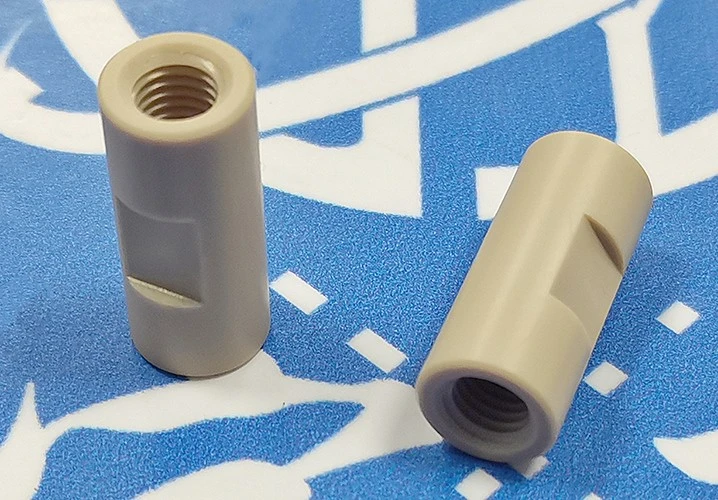

An elastic seal can provide a better seal around the instrument components, preventing the ingress of contaminants or the leakage of the sample fluid. For example, in a gas chromatography instrument, a well - sealed labyrinth seal can ensure that the gas sample is accurately analyzed without any leakage or interference from the outside environment.
Application in Five - nozzle Connector
Labyrinth seals can also be used in Five - nozzle Connector applications. In these connectors, the seal needs to provide a reliable connection between the nozzles while preventing fluid leakage. The elasticity of the seal material is crucial in ensuring a proper fit and seal.
An elastic seal can deform to create a tight seal around the nozzles, even if there are small manufacturing tolerances or misalignments. This helps to maintain the integrity of the fluid flow in the connector and prevent any cross - contamination between the different nozzles.
Use in Radome
In Radome applications, labyrinth seals are used to protect the antenna from environmental factors while allowing the electromagnetic waves to pass through. The material elasticity of the seal can affect its ability to withstand the mechanical stresses caused by wind, temperature changes, and vibrations.
An elastic seal can deform to absorb these mechanical stresses without losing its sealing properties. This is important for maintaining the protection of the antenna and ensuring the proper functioning of the radome.
Selecting the Right Elastic Material
As a labyrinth seal supplier, selecting the right elastic material is crucial. Different applications have different requirements in terms of pressure, temperature, fluid type, and vibration levels. For high - pressure applications, a material with a relatively high Young's modulus may be required to prevent excessive deformation, while for applications with high - vibration levels, a more elastic material may be preferred for better vibration damping.
Some common materials used for labyrinth seals include polymers, elastomers, and metals. Polymers such as PEEK (polyether ether ketone) are known for their good chemical resistance and moderate elasticity, making them suitable for a wide range of applications. Elastomers like rubber have high elasticity and are often used in applications where a high degree of sealing flexibility is required. Metals, on the other hand, have high stiffness and are used in high - temperature and high - pressure applications where dimensional stability is crucial.
Conclusion
The material elasticity of a labyrinth seal has a profound impact on its performance. It affects leakage reduction, vibration damping, thermal expansion compatibility, and its suitability for various applications such as those involving Analytical Instrument Accessories, Five - nozzle Connector, and Radome.
As a labyrinth seal supplier, we understand the importance of selecting the right material with the appropriate elasticity for each specific application. We can provide customized solutions based on our customers' requirements to ensure optimal performance of the labyrinth seals. If you are in need of high - quality labyrinth seals for your industrial applications, please feel free to contact us for a detailed discussion and procurement negotiation.
References
- Chen, J., & Li, Y. (2018). Study on the leakage characteristics of labyrinth seals considering the influence of material properties. Journal of Tribology, 140(3), 031702.
- Smith, R. W. (2019). Design and performance analysis of labyrinth seals in rotating machinery. ASME Press.
- Wang, X., & Zhang, H. (2020). Effect of material elasticity on the dynamic behavior of labyrinth seals. Journal of Sound and Vibration, 465, 115234.